Air Conditioning
Air Conditioning
During the hottest time of the year in most climates around the world, one great savior from the heat is the air conditioning equipment installed in the home or work place where it's needed most.
It dries the indoor atmosphere and cools the climate to a comfortable temperature, making it a more welcoming and habitable environment for us to live or work in.
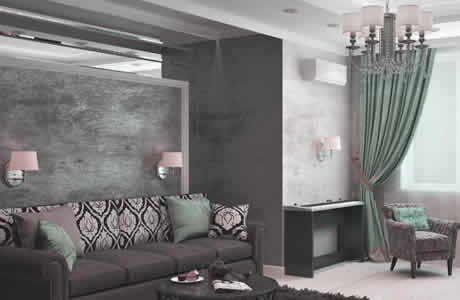 Let's take a look at what air conditioning is and how it works to keep us feeling nice and cool wherever it is deployed.
What is Air Conditioning?
Simply put, it is a system that cools the air inside a building. Well, that is obvious enough, so let's take a look at it in a little more detail.
Here we have some equipment that can take on a number of forms and sizes that essentially draws warm, moist air into itself from the space it services. It passes that air through its system where it is dried and chilled, with the resulting cold, dry air expelled back into the space to be serviced.
This results in a lowering of the room temperature and humidity, thereby creating a more comfortable microclimate in that space.
Types of AC
This equipment can be a large, central, whole-building system that collects warm air from all the rooms and spaces in a building and returns cold air to those rooms and spaces. This is generally known as central AC (Air Conditioning) or central HVAC (Heating, Ventillation, Air Conditioning) when it also creates warm air during the cold winter months as needed.
The system can also be distributed into zones in a building using smaller, individual units called ductless mini-split air conditioners. These have pairs of units for each room in a building, with an internal unit that draws warm air in and returns cold air; and an external unit (the condenser) that has a powerful fan for extracting the hot, moist air from the system to the outside.
There are also individual window air conditioners that are single units mounted in a window opening and do both jobs of drawing warm air in, processing it and returning cold air to the room while expelling the hot, moist air to the outside.
And finally we have the individual portable air conditioners, which are stand alone, or free standing units mounted on wheels and also perform both tasks of drawing air in and producing cold air while expelling the hot exhaust out through a convenient opening such as a window or a wall vent via a flexible plastic hose.
How Does Air Conditioning Work?
Internally, the equipment performs a systematic chilling of the air drawn into itself from the space to be cooled. It does this using a refrigeration process similar to that employed by the kind of domestic refrigerator most people have in their kitchens.
The kitchen fridge has a much smaller volume to keep cool, but it does it by extracting the air from the food box, forcing it through a chilled radiator of cold thin pipes filled with a refrigeration gas which chills the air that is then returned to the interior food box.
An air conditioner works in the same way, only on a larger scale to cool a much larger space.
Refrigeration Cycle
The refrigeration process works on a cycle, where the gas is compressed (in a compressor) which raises its temperature dramatically. The compressed gas is then released to the condenser, where it condenses as a liquid as its temperature drops rapidly.
This cold liquid is pumped through and chills the pipes needed to cool the air being circulated over them. As the gas is warmed, it returns to the compressor for the cycle to begin anew.
The cycle produces cold air (that is used to to cool the space) and hot air that is exhausted from the unit to the outside.
Cooling at a Cost
The major downside to air conditioning is that it uses a lot of energy to run the equipment. This represents a large percentage of a household's electricity consumption and since energy prices are continually rising, this can work out to be expensive.
However, there are ways in which a household (or a business) can reduce this expense. Here are a few ideas that can be put into practice that can make a difference.
How to Keep AC Costs Down
By employing common sense practices, such as setting the thermostat to a reasonable level and not too cold and only having the AC turned on when there are actually people occupying the building, the amount of energy used can be greatly reduced.
Closing the Gaps
Maintaining the building in good repair can also have some influence on the amount of energy used, as cracks in walls and gaps in window and door frames can allow airflow into and out of the building, causing the AC system to work harder (and thus use more energy) to maintain the temperature set by the thermostat.
The last thing you want is to see all your hard-earned dollars sneaking out through the cracks and gaps in the form of cool air made by your AC system that you're paying mightily for!
Insulation
Insulating the building can also help to reduce the expense by increasing the building's ability to keep the cool air in and the hot air out.
That includes having insulation in the attic space to act as a radiant barrier, keeping the heat on the outside while helping to keep the cool on the inside.
While it is convenient and comfortable to be able to come home to a cool house thanks to its air cooling system, it should always be remembered that comfort comes at a cost. The level of that cost is to some extent reliant on how sensibly the cooling system is used.
- Copyright © s3.ca-central-1.amazonaws.com/aircon.com All rights reserved
- Privacy