Two questions come up again and again before anyone books a nose piercing in Mississauga. Parents and teens want to know the age and ID rules, and nearly everyone wants to know how to tell a safe studio from a risky one. Both questions deserve a straight answer, because a nose piercing is a small procedure that breaks the skin, and the studio standards behind it decide how cleanly it heals. This covers what a reputable Cooksville studio asks for in terms of age and consent, why needle-only piercing is the safety line that separates professional studios from mall kiosks, and the aftercare that actually keeps a fresh nose piercing clean. None of it is complicated, but all of it matters for a piercing that heals over months rather than days.
Age and ID Rules in Ontario
Ontario does not set one single legal age for body piercing, so responsible studios set and publish their own age and consent policy, and a client should always check it before going in. At Xtremities, a minor can be pierced with a parent or legal guardian present who provides valid photo identification and gives consent in person. Older minors and adults bring their own government-issued photo ID. The exact arrangement for a given age is confirmed when the appointment is booked, so families know what to bring before they make the trip to Dundas Street. The reason for the ID and consent steps is not red tape. A piercing is a procedure that breaks the skin and needs months of aftercare, so a studio confirming that a minor has a parent or guardian on board is protecting the young client and setting the aftercare up to succeed. A studio that pierces a minor with no ID and no parent is a studio cutting corners it should not cut. Clear, posted age rules are a sign of a shop that takes the responsibility seriously.
Ontario has no single legal piercing age
Ontario law does not set one fixed age for body piercing, so responsible studios set and publish their own age and consent policy. A studio that pierces a minor with a parent or guardian present and valid photo ID is protecting the young client and the healing, while one that skips ID and consent is cutting corners.
Piercing guns can shatter cartilage
The blunt force a piercing gun delivers can shatter cartilage rather than pass through it cleanly, which is why guns are especially dangerous near a septum or high nostril. Public Health Ontario guidance also flags guns for contamination and reprocessing risks, since the housing cannot be fully sterilized between clients.
Most nose bumps are irritation, not keloids
The small raised bump that can appear beside a healing nostril piercing is usually an irritation bump caused by movement, a knock, or a poorly fitted post, not a keloid. Irritation bumps commonly settle once the cause is removed, often by downsizing the jewelry and returning to a simple saline routine.
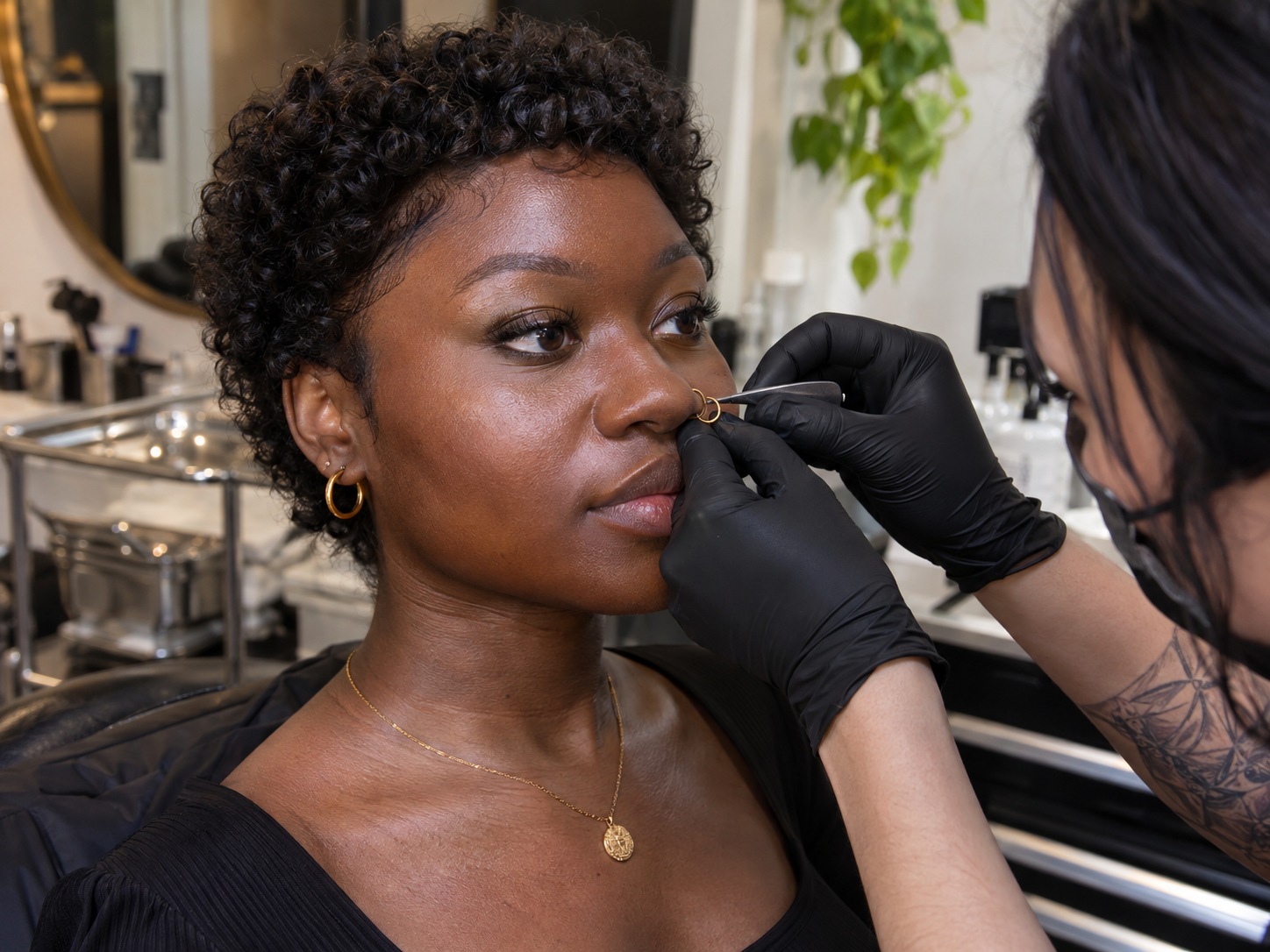
The single clearest safety line in piercing is needle versus gun. A professional studio pierces a nose freehand with a single-use sterile hollow needle, which cuts a clean channel through the tissue and is thrown away immediately after one use. A mall kiosk piercing gun forces jewelry through with blunt pressure, which crushes and tears tissue rather than cutting it, and the plastic gun housing cannot be put through an autoclave, so it cannot be fully sterilized between clients. For a nose, and especially for a septum, the difference is not subtle. A gun is particularly dangerous near cartilage. The blunt force that a gun delivers can shatter cartilage rather than pass through it cleanly, which is why guns have no business anywhere near a septum or a high nostril. Public Health Ontario guidance flags piercing guns for contamination and reprocessing risks for exactly these reasons. Clients across the GTA have learned to filter out guns and mall kiosks and search specifically for needle-only studios, which is the right instinct. Xtremities uses single-use needles for every piercing, with no exceptions.
Peel Public Health Standards and 25 Years of Safe Piercings
Because a nose piercing breaks the skin, the studio is inspected by Region of Peel Public Health under Ontario Personal Service Settings Regulation 136/18, the provincial rule for any personal service setting that pierces or cuts skin. That regulation sets standards for single-use equipment, sterilization, and record keeping. At Xtremities, reusable tools are cleaned in an ultrasonic bath, pouched, and sterilized in a medical-grade autoclave, and the autoclave is checked with biological indicator spore testing that confirms it actually kills everything it should. Aseptic skin prep before the piercing keeps the site clean from the start. Standards on paper mean more when a studio has honoured them for decades. Xtremities has pierced in Cooksville for more than 25 years as the longest-running tattoo and piercing studio in Mississauga and a two-time Readers' Choice winner. That longevity rests on getting sterilization, single-use needles, and clean technique right every single day, which is exactly the foundation a nose piercing needs. A client is trusting a studio with an open wound on their face, and the track record behind the needle is a fair thing to weigh.
Aftercare That Actually Works
Aftercare for a nose piercing is simple and built on sterile saline. A 0.9 percent sodium chloride solution, either a piercing-specific saline spray such as the widely used NeilMed product or a gentle soak, cleans the piercing once or twice a day and lifts away crusting without stinging or drying the tissue. What a nose piercing should never meet is alcohol, hydrogen peroxide, or harsh antibacterial soaps, which kill the new tissue the body is building and slow healing rather than helping it. Clean hands before touching the piercing at all, and otherwise leave it alone. The strongest aftercare habit is doing less. A fresh nose piercing that is twisted, rotated, or constantly checked heals worse than one that is cleaned and left in peace. The old advice to turn the jewelry is outdated and wrong, since turning drags crusting through the healing channel. For a nostril, be careful with the edge of a towel and with glasses that rest near the piercing, and resist changing the jewelry until the piercing is fully healed and downsized. Simple saline, clean hands, and patience heal a nose piercing better than any product a shop might try to sell.
Healing Timelines and Bumps
A nostril piercing generally takes several months to fully heal, and a septum through the soft sweet spot often heals faster than people expect, though both feel settled on the surface long before they are healed underneath. The most common worry during healing is a small raised bump beside a nostril piercing. In most cases this is an irritation bump, caused by movement, a knock, early jewelry changes, or a too-tight or poorly fitted post, rather than a keloid. Irritation bumps usually settle once the cause is removed, often by downsizing the jewelry and returning to a simple saline routine. A true keloid, an overgrowth of scar tissue, is far less common than the internet suggests and is different from an ordinary irritation bump. Signs of actual infection, such as increasing pain, spreading redness, heat, swelling that worsens rather than settles, or thick discoloured discharge, are uncommon and warrant prompt attention rather than waiting. The reassuring reality is that a nose piercing placed cleanly with a needle, fitted in titanium, downsized on time, and cleaned simply tends to heal without any of this. When something looks off, the piercer who did the work is the right first call, which is one more reason to get pierced close to home.
Walk-Ins and What to Bring
A nose piercing does not always need an appointment. Xtremities takes walk-ins seven days a week, Monday through Saturday from noon to 9 PM and Sunday from noon to 6 PM, so a client can come in when it suits them, though booking ahead smooths out busy weekend stretches. What to bring is simple. Adults bring valid government-issued photo ID, and minors bring a parent or legal guardian with photo identification per the studio age policy. Eating a proper meal beforehand helps, since a steady blood sugar level makes the whole experience easier and reduces lightheadedness. The studio sits at 37 Dundas Street West in the Cooksville core, at the Dundas and Hurontario intersection locals call the 5 and 10, a short walk from Cooksville GO Station and on the MiWay Dundas route for clients coming in without a car. Clients travel in from Port Credit, Streetsville, Erindale, Lorne Park, Clarkson, Square One, and across the GTA West from Oakville, Brampton, and Etobicoke. A free anatomy consultation comes before any piercing, so there is time to ask questions and confirm the placement before anything happens.
What the Appointment Feels Like
Knowing what happens at the appointment takes a lot of the nerves out of a first nose piercing. It starts with the consultation, where the piercer looks at the nose, discusses the placement the client wants, and checks that the anatomy supports it. For a nostril, that means finding the spot on the crease that flatters the face. For a septum, it means locating the soft sweet spot below the cartilage. The piercer then marks the entry and exit points with a skin-safe marker and hands over a mirror, and nothing happens until the client agrees the marks look right. The pierce itself is fast. A single-use hollow needle passes through the marked tissue in one controlled motion and the pre-fitted jewelry follows it through. A nostril is a quick sharp pinch, and a septum through the sweet spot is a strong pressure that can make the eyes water for a second. Both are over in moments, and the piercer talks the client through each step as it happens. The marking and consultation take longer than the pierce, which is exactly as it should be, since the placement is the part that lasts for years.
Nostril or Septum for a First Piercing
First-timers often ask which nose piercing to start with, and both the nostril and the septum are reasonable first piercings when placed well. The nostril is the most popular starting point because the placement is flexible and the look is classic, sitting a small stud or, once healed, a ring on the curve of the nostril. It suits almost any nose and is easy to style over time. The main care point is keeping it from being knocked during the months it heals. The septum appeals to first-timers who want something they can hide for work or family, since the jewelry can be flipped up inside the nose. A septum through the true sweet spot heals well and sits comfortably, and it avoids the visible-bump worry that sometimes troubles a nostril. The honest answer on which to choose comes from the consultation, where the piercer weighs the look the client wants against what their anatomy supports. Either way, starting with a needle, titanium jewelry, and a studio that marks carefully sets a first piercing up to heal cleanly. First-timers also do well to think about timing and lifestyle before booking. A nose piercing heals over months, so it helps to avoid starting one right before a beach vacation, a swim-heavy season, or anything that puts the fresh piercing under water or a mask for long stretches. Contact sports, a job that involves a respirator, and frequent face-down massage all interact with a healing nose piercing, so a quick word about daily routine at the consultation lets the piercer flag anything worth planning around. None of these rule out a piercing, they simply shape the best time to get one. The reassuring bottom line is that a nose piercing done the right way is a small, well-understood procedure with a long track record. A single-use needle, implant-grade titanium, careful marking, clean technique under Peel Public Health standards, and a simple saline routine are the whole recipe, and they have healed countless noses at the Cooksville studio over 25 years. A client who picks the placement that suits their anatomy and follows the aftercare ends up with a piercing that settles cleanly and looks right for years.
Book a Nose Piercing in Cooksville, Mississauga
Anyone ready for a nostril or septum piercing can start with a free anatomy consultation at Xtremities Tattoo and Piercing, a two-time Readers' Choice winner and the longest-running tattoo and piercing studio in the city, open since 2000. The studio sits at 37 Dundas Street West in the Cooksville core, right at the Dundas and Hurontario intersection that locals call the 5 and 10, a short walk from Cooksville GO Station and the MiWay Dundas route. It serves clients from Port Credit, Streetsville, Erindale, Lorne Park, Clarkson, Square One, and across the GTA West including Oakville, Brampton, and Etobicoke. Walk-ins are welcome seven days a week, Monday through Saturday from noon to 9 PM and Sunday from noon to 6 PM, and minors are pierced with a parent or guardian present and valid photo ID per the studio age policy. To book a nose piercing or ask a question, call Xtremities at (905) 897-3503 or visit xtremities.ca/nose-piercing-studio-mississauga-on.
Body piercing is a form of body modification involving the puncturing or cutting a part of the body to create an opening through which jewelry or implants can be worn or inserted. The word piercing can refer to the act or practice of body piercing, or to an opening in the body created by this act or practice. It can also, by metonymy, refer to the resulting decoration, or to the decorative jewelry used. Piercing implants alter the body and/or skin profile and appearance (e.g. golden threads installed subdermal, platinum, titanium or medical grade steel subdermal implants).
Ear piercing and nose piercing have been particularly widespread and are well represented in historical records and among grave goods. The oldest mummified remains ever discovered had earrings, attesting to the existence of the practice more than 5,000 years ago. Nose piercing is documented as far back as 1500 BCE. Piercings of these types have been documented globally, while lip and tongue piercings were historically found in some African cultures. Nipple and genital piercing have also been practiced by various cultures, with nipple piercing dating back at least to Ancient Rome while genital piercing is described in Ancient India c. 320 to 550 CE. The history of navel piercing is less clear. The practice of body piercing has waxed and waned in Western culture, but it has experienced an increase in popularity since World War II, with sites other than the ears gaining subcultural popularity in the 1970s and spreading to the mainstream in the 1990s.
The reasons for piercing or not piercing are varied. Some people pierce for religious or spiritual reasons, while others pierce for self-expression, for aesthetic value, for sexual pleasure, to conform to their culture or to rebel against it. Some forms of piercing remain controversial, particularly when applied to youth. The display or placement of piercings have been restricted by schools, employers and religious groups. In spite of the controversy, some people have practiced extreme forms of body piercing, with Guinness bestowing World Records on individuals with hundreds and even thousands of permanent and temporary piercings.
Contemporary body piercing practices emphasize the use of safe body piercing materials, frequently utilizing specialized tools developed for the purpose. Body piercing is an invasive procedure with some risks, including allergic reaction, infection, excessive scarring and unanticipated physical injuries, but such precautions as sanitary piercing procedures and careful aftercare are emphasized to minimize the likelihood of encountering serious problems. The healing time required for a body piercing may vary widely according to placement, from as little as a month for some genital piercings to as much as two full years for the navel. Some piercings may be more complicated, leading to rejection.
An earring found in an Alamannic grave in Germany, dated c. 6th or 7th century
Body adornment has only recently become a subject of serious scholarly research by archaeologists, who have been hampered in studying body piercing by a scarcity of primary sources.[1] Early records rarely discussed the use of piercings or their meaning, and while jewelry is common among grave goods, the deterioration of the flesh that it once adorned makes it difficult to discern how the jewelry may have been used.[1]
The modern record has been also distorted by the 20th-century inventions of piercing enthusiast Doug Malloy.[1] In the 1960s and 1970s, Malloy marketed contemporary body piercing by giving it the patina of history.[2] His pamphlet Body & Genital Piercing in Brief included such commonly reproduced urban legends as the notion that Prince Albert invented the piercing that shares his name in order to diminish the appearance of his large penis in tight trousers, and that Roman centurions attached their capes to nipple piercings.[3][4] Some of Malloy's myths were reprinted as fact in subsequently published histories of piercing.[1]
Ear piercing has been practiced all over the world since ancient times, and there is considerable written and archaeological evidence of the practice. Mummified bodies with pierced ears have been discovered, including the oldest mummified body discovered to date, the 5,300-year-old Ötzi the Iceman, which was found in a glacier in Italy.[5] The mummy had an ear piercing 7–11 mm (0.28–0.43 in) in diameter.[5] The oldest earrings were found in Sumer, in the Royal Cemetery of Ur, dating to c. 2550 BCE during the Early Dynastic Period III.[6][7] Earrings are mentioned in the Bible. In Genesis 35:4,[8]Jacob buries the earrings worn by members of his household along with their idols under a tree. In Exodus 32,[9]Aaron makes the golden calf from melted earrings. Deuteronomy 15:12–17[10] dictates ear piercing for a slave who chooses not to be freed.[11] Earrings are also referenced in connection to the Hindu goddess Lakshmi in the Vedas.[1] Earrings for pierced ears were found in a grave in the Ukok region between Russia and China dated between 400 and 300 BCE.[12]
Among the Tlingit people of the Pacific Northwest of America, earrings were a sign of nobility and wealth, as the placement of each earring on a child had to be purchased at an expensive potlatch.[13] Earrings were common in the Eighteenth dynasty of Egypt (1550–1292 BCE), generally taking the form of a dangling, gold hoop.[14] Gem-studded, golden earrings shaped like asps seem to have been reserved for nobility.[15] The ancient Greeks wore paste pendant earrings shaped like sacred birds or demigods, while the women of ancient Rome wore precious gemstones in their ears.[16]
In Europe, earrings for women fell from fashion generally between the 4th and 16th centuries, as styles in clothing and hair tended to obscure the ears, but they gradually thereafter came back into vogue in Italy, Spain, England and France—spreading as well to North America—until after World War I when piercing fell from favor and the newly invented Clip-on earring became fashionable.[17][18][19] According to The Anatomie of Abuses by Philip Stubbs, earrings were even more common among men of the 16th century than women, while Raphael Holinshed in 1577 confirms the practice among "lusty courtiers" and "gentlemen of courage."[20] Evidently originating in Spain, the practice of ear piercing among European men spread to the court of Henry III of France and then to Elizabethan era England, where earrings (typically worn in one ear only) were sported by such notables as Robert Carr, 1st Earl of Somerset, Shakespeare, Sir Walter Raleigh and Charles I of England.[20] Common men wore earrings as well. From the European Middle Ages, a superstitious belief that piercing one ear improved long-distance vision led to the practice among sailors and explorers.[21] Sailors also pierced their ears in the belief that their earrings could pay for a Christian burial if their bodies washed up on shore.[22]
Nose piercing also has a long history. c. 1500 BCE, the Vedas refer to Lakshmi's nose piercings,[1] but modern practice in India is believed to have spread from the Middle Eastern nomadic tribes by route of the Mughal emperors in the 16th century.[23] It remains customary for Indian Hindu women of childbearing age to wear a nose stud, usually in the left nostril, due to the nostril's association with the female reproductive organs in Ayurvedic medicine.[24][25] This piercing is sometimes done the night before the woman marries.
In Genesis 24:22,[26]Abraham's servant gives Rebecca a nose ring. Nose piercing has been practiced by the Bedouin tribes of the Middle East and the Berber and Beja peoples of Africa,[27] as well as Australian Aboriginals.[28] Many Native American and Alaskan tribes practiced septum piercing. It was popular among the Aztecs, the Mayans and the tribes of New Guinea, who adorned their pierced noses with bones and feathers to symbolize wealth and (among men) virility.[21] The name of the Nez Perce tribe was derived from the practice, though nose piercing was not common within the tribe.[29] The Aztecs, Mayans and Incas wore gold septum rings for adornment, with the practice continued to this day by the Guna of Panama.[27] Nose piercing also remains popular in Pakistan and Bangladesh and is practiced in a number of Middle Eastern and Arab countries.[27]
Lip piercing and lip stretching were historically found in certain tribal cultures in Africa and the Americas. Pierced adornments of the lip, or labrets, were sported by the Tlingit as well as peoples of Papua New Guinea and the Amazon basin.[12] Aztecs and Mayans also wore labrets, while the Dogon people of Mali and the Nuba of the Nile Valley wore rings.[30] The practice of stretching the lips by piercing them and inserting plates or plugs was found throughout Pre-Columbian Mesoamerica and South America as well as among some of the tribes of the Pacific Northwest and Africa.[31] In some parts of Malawi, it was quite common for women to adorn their lips with a lip disc called a "pelele" that by means of gradual enlargement from childhood could reach several inches of diameter and would eventually alter the occlusion of the jaw.[32][33] Such lip stretching is still practiced in some places. Women of the NiloticMursi tribe in the Nile Valley wear lip rings on occasion that may reach 15 centimetres (5.9 in) in diameter.[34]
In some Pre-Columbian and North American cultures, labrets were seen as a status symbol.[35] They were the oldest form of high status symbol among the Haida women, though the practice of wearing them died out due to Western influence.[36]
Tongue piercing was practiced by the Aztec, Olmec and Mayan cultures as a ritual symbol.[12][21] Wall paintings highlight a ritual of the Mayans during which nobility would pierce their tongues with thorns. The blood would be collected on bark, which would be burned in honor of the Mayan gods.[37] It was also practiced by the Haida, Kwakiutl and Tlingit, as well as the Fakirs and Sufis of the Middle East.[30]
The history of nipple piercing, navel piercing, and genital piercing has been particularly misrepresented by printed works continuing to repeat myths that were originally promulgated by Malloy in the pamphlet Body & Genital Piercing in Brief.[1][4] For example, according to Malloy's colleague Jim Ward, Malloy claimed navel piercing was popular among ancient Egyptian aristocrats and was depicted in Egyptian statuary,[4] a claim that is widely repeated.[38][39] Other sources say there are no records to support a historical practice for navel piercing.[40]
However, records do exist that refer to practices of nipple and genital piercing in various cultures prior to the 20th century. Kama Sutra, dated to the Gupta Empire of Ancient India, describes genital piercing to permit sexual enhancement by inserting pins and other objects into the foreskin of the penis.[12] The Dayak tribesmen of Borneo passed a shard of bone through their glans for the opposite reason, to diminish their sexual activity.[41] In the Talmud (Tractate Shabbat 64a), there may be mention of a genital piercing in the prohibition against the kumaz, which medieval French Talmudic commenter Rashi interpreted as a chastity piercing for women.[42] Other interpreters have, however, suggested that the kumaz was rather a pendant shaped like a vulva or a girdle.[43][44]
Nipple piercing may have been a sign of masculinity for the soldiers of Rome.[45] Nipple piercing has also been connected to rites of passage for both British and American sailors who had traveled beyond a significant latitude and longitude.[23] It is widely reported that in the 1890s, nipple rings called "bosom rings" resurfaced as a fashion statement among women of the West, who would wear them on one or both sides, but if such a trend existed, it was short-lived.[23][46]
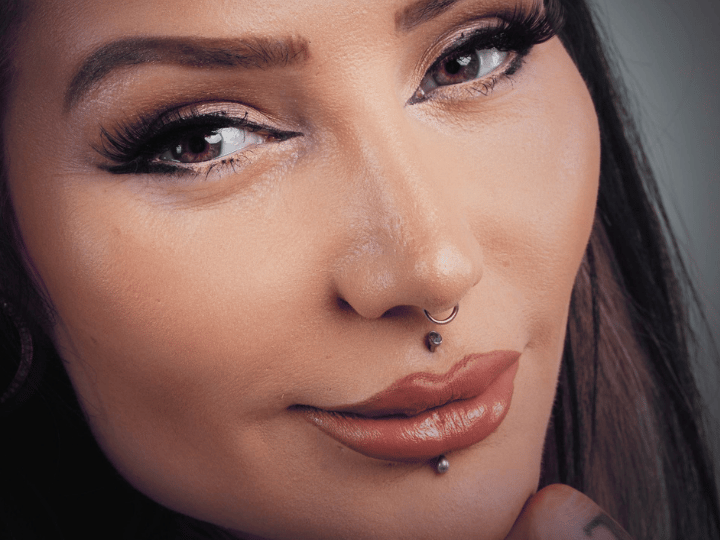
Person with several facial piercings (Monroe, Septum and Lip)
By the early part of the 20th century, piercing of any body part other than the ear lobe had become uncommon in the West.[47] After World War II, it began increasing in popularity among the gay malesubculture.[47]Clip-on earrings were primarily the preferred fashion in the 1920s; however, the physical piercing of lobes began growing in popularity from the 1960s.[47] In the 1970s, piercing began to expand, as the punk movement embraced it, featuring nontraditional adornment such as safety pins; and Fakir Musafar began popularizing it as a form of Modern Primitivism, which incorporated piercing elements from other cultures, such as stretching.[47]
Body piercing was also heavily popularized in the United States by a group of Californians, including Doug Malloy and Jim Ward.[48] Ward (inspired by and with money from Malloy) opened The Gauntlet as a home business in November 1975 and then as a commercial storefront operation in West Hollywood on 17 November 1978. The establishment of this business – considered the first of its type in the United States[49] – was the beginning of the body piercing industry.[49][50][51] As word of body piercing spread to the wider community, Ward began to publish the first publication dedicated to the subject, PFIQ.[52]
A table in Larry Townsend's The Leatherman's Handbook II (the 1983 second edition; the 1972 first edition did not include this list) which is generally considered authoritative states that a purple handkerchief is a symbol for body piercing in the handkerchief code, which is employed usually among gay male casual-sex seekers or BDSM practitioners in the United States, Canada, Australia and Europe. Wearing the handkerchief on the left indicates the top, dominant, or active partner; right the bottom, submissive, or passive partner. However, negotiation with a prospective partner remains important because, as Townsend noted, people may wear hankies of any color "only because the idea of the hankie turns them on" or "may not even know what it means".[53]
A significant development in body piercing in England occurred in 1987, when during Operation Spanner, a group of homosexuals—including well known body piercer Alan Oversby—were convicted of assault for their involvement in consensualsadomasochism over a 10-year period, including acts of body piercing.[52] The courts declared that decorative body piercing was not illegal, but that erotic body piercing was.[54] Subsequently, the group Countdown on Spanner formed in 1992 in protest. The group appealed the decision before the High Court of Justice, the House of Lords and finally the European Commission of Human Rights, attempting to overturn the verdict which ruled consent immaterial in acts of sadomasochism, without success.[55] In spite of their repeated failures, the situation publicized the issue, with The Times editorializing the court's decision as "illiberal nonsense" in 1993.[55] In 1996 Countdown on Spanner received the Large Nonprofit Organization of the Year award as part of the Pantheon of Leather Awards.[56]
Body modification in general became more popular in the United States in the 1990s, as piercing also became more widespread, with growing availability and access to piercings of the navel, nose, eyebrows, lips, tongue, nipples, and genitals.[47] In 1993, a navel piercing was depicted in MTV Video Music Awards' "Music Video of the Year", "Cryin'", which inspired a plethora of young female fans to follow suit.[48] According to 2009's The Piercing Bible, it was this consumer drive that "essentially inspired the creation of body-piercing as a full-fledged industry."[57] Body piercing was given another media-related boost in 2004, when during a halftime performance at Super Bowl XXXVIII, singer Janet Jackson experienced a "wardrobe malfunction" that left exposed Jackson's pierced nipple.[58] Some professional body piercers reported considerable increases in business following the heavily publicized event.[58]
Two young women with navel piercings, 2004
Alongside traditional piercing techniques, modern body adornment includes variant techniques such as pocketing and flesh stapling, although as of 2007[update] these were still not widely made available by piercers.[59] In the first of these, a scalpel opens the skin or mucous membranes, into which the larger end of a piece of jewelry or—if using a bar—two ends are inserted.[60][61] These kinds of piercings may be difficult to remove, as fibrous tissue can form around the end or ends of the jewelry or the implanted tube into which the jewelry is placed. When a bar is used, pocketing looks quite similar to flesh stapling.[60] The latter technique is frequently done in the form of a ladder.[61] Modern body piercing practices also include dermal anchoring or dermal piercing, which combines piercing and implantation to create a single point of opening in the body (whereas pocketing creates two) to permit one end of the jewelry to show above the surface of the skin.[62] While this technique can be performed almost anywhere on the body, as of 2007[update] it was popularly done between the eyes, on the chest, or on the finger, to simulate a ring.
The practice of body piercing is subject to trends and fashions. Belly button and eyebrow piercings were popular during the 1990s when the piercing trend entered the mainstream. In 2015, the septum piercing and nipple piercing were considered highly fashionable.[66][67][68][69] Additionally, the practice of ear lobe gauging or stretching has become popular with the turn of the century.[70]
A 2005 survey of 10,503 people in England over the age of 16 found that approximately 10% (1,049) had body piercings in sites other than the earlobe, with a heavy representation of women aged 16–24 (46.2% piercing in that demographic).[71] Among the most common body sites, the navel was top at 33%, with the nose and ear (other than lobe) following at 19% and 13%. The tongue and nipple tied at 9%. The eyebrow, lip and genitals were 8%, 4% and 2%, respectively.[71] Preference among women followed closely on that ranking, though eyebrow piercings were more common than nipple piercings. Among male responders, the order was significantly different, descending in popularity from nipple, eyebrow, ear, tongue, nose, lip and genitals.[71]
A cross-cultural study published in 2011 found that individuals with piercings were likely to be involved in other forms of countercultural expression as well.[72]
A Tamil man in a religious procession with a trident piercing his cheeks
Reasons for piercing vary greatly. A 2001 survey in Clinical Nursing Research, an international publication, found that 62% of people who have had piercings have done so in an effort "to express their individuality."[73] People also pierce to commemorate landmark events or to overcome traumatic ones.[74] According to the assistant director of the Frankfurt University Teaching Hospital for Psychosomatic Medicine and Psychotherapy, some sexual abuse survivors choose body piercing as a means of "reclaiming body parts from memories of abuse".[75] Piercing can also be chosen for simple aesthetic value, to highlight particular areas of the body, as a navel piercing may reflect a woman's satisfaction with the shape and condition of her stomach.[76] Some people pierce, permanently or temporarily, to enhance sexual pleasure. Genital and nipple piercings may increase sexual satisfaction.[73][77] Some people participate in a form of body play known as play piercing, in which piercings may be done temporarily on the genitals or elsewhere on the body for sexual gratification.[78]
Piercing combined with suspension was historically important in the religious ceremonies of some Native Americans, featuring in many variants of the Sun Dance ceremony,[47] including that practiced by the Crow Nation.[79] During the Crow ceremony, men who wished to obtain visions were pierced in the shoulders or chest by men who had undergone the ceremony in the past and then suspended by these piercings from poles in or outside of the Sun Dance Lodge. Some contemporary Southeast Asian rituals also practice body piercing, as a form of spiritual self-mortification. Generally, the subject attempts to enter an analgesic trance prior to the piercing.[80]
Cheek piercing at a ritual in Qionghai, Hainan, China
Bridging the gap between self-expressive piercing and spiritual piercing, modern indigenous people may use piercing and other forms of body modification as a way of ritually reconnecting with themselves and society, which according to Musafar once used piercing as a culturally binding ritual.[75] But at the same time that piercing can be culturally binding, it may also be a means of rebellion, particularly for adolescents in Western cultures.[81]
A fifteen-year analysis published in 2011, Body Piercing and Identity Construction, found that public piercing served as a mechanism of both accelerated camaraderie and political communication, while private piercings served to enhance sexuality and contest heteronormativity.[72]
While body piercing has grown more widespread, it remains controversial. Some countries impose age of consent laws requiring parental permission for minors to receive body piercings.[82] Scotland requires parental consent for persons under 16, while in 2011 Wales began considering a similar law.[83] In addition to imposing parental consent requirements, Western Australia prohibits piercing body parts of minors, including genitals and nipples, on penalty of fine and imprisonment for the piercer.[84][85] Many states in the U.S. also require parental consent to pierce minors, with some also requiring the physical presence of the parents during the act.[86] The state of Idaho has imposed a minimum age for body piercing at 14.[86]
In 2004, controversy erupted in Crothersville, Indiana, when a local high school featured a spread on "Body Decorations" in its yearbook that featured tattoos and body piercings of teachers and students.[87] That same year, in Henry County, Georgia, a 15-year-old boy remained in in-school suspension for a full month for violating school policy by wearing eyebrow, nose, labret and tongue piercings to school. His mother subsequently decided to homeschool him.[88][89] As of 2022, the school district has maintained its policy against body piercing.[90]
According to 2006's Tattoos and Body Piercing, corporate dress codes can also strictly limit piercing displays. At that time, Starbucks limited piercings to two per ear and jewelry to small, matched earrings.[91] Employees of Walt Disney Parks and Resorts were not permitted to display piercings at all.[92] However, also in 2006, amid a series of employment discrimination cases in the United States, it became clear that the legality of these dress codes depended upon broader social acceptance of body piercing.[93] As early as 2011, some management literature acknowledged that workplace prohibitions on body modification could negatively impact human resources development; one author compared the practice to older prohibitions on long hair.[94] As of 2020, employment discrimination based on personal appearance including body piercings may be illegal in France.[95]
Body piercing in some religions is held to be destructive to the body. Some passages of the Bible, including Leviticus 19:28,[92] have been interpreted as prohibiting body modification because the body is held to be the property of God.[22]The Church of Jesus Christ of Latter-day Saints has taken an official position against most piercings unless for medical reasons, although they accept piercings for women as long as there is only one set of piercings in the lower lobe of the ears and no other place on the body.[96] Wearing of very large nose rings on Shabbat is forbidden by the Talmud.[28]
In 2018 the first piercing business in the UAE was opened in Dubai[97] by American piercer, Maria Tash.
Elaine Davidson, the "Most Pierced Woman" in the world as of 2009
Officially titled "Most Pierced Woman", Elaine Davidson of Brazil holds the Guinness World Record for most permanent piercings, first setting this record in 2000 upon verification by Guinness judges of 462 body piercings, with 192 at the time being around her head and face.[98] As of 8 June 2006, her Guinness-certified piercings numbered 4,225.[99] In February 2009, The Daily Telegraph reported that she had 6,005.[98] The "Most Pierced Man" as of 2009 was Luis Antonio Agüero, who had 230 permanent piercings, with 175 rings adorning his face alone.[99]
In January 2003, Canadian Brent Moffat set the World Record for most body piercings in one session (700 piercings with 18g surgical needles in 1 session of 7 hours, using play piercing where the skin is pierced and sometimes jewelry is inserted, which is worn temporarily).[100] In December of the same year, Moffat had 900 piercings in 4½ hours.[101] On 4 March 2006, the record was overturned by Kam Ma, who had 1,015 temporary metal rings inserted in 7 hours and 55 minutes.[99] The record for most body piercings with surgical needles was set on 29 May 2008, when Robert Jesus Rubio allowed 900 18-gauge, 0.5 centimetres (0.20 in)-long surgical needles to be inserted into his body.[102]
Body piercing jewelry should be hypoallergenic.[103] A number of materials are used, with varying strengths and weaknesses. Surgical stainless steel, niobium and titanium are commonly used metals, with titanium the least likely to cause allergic reaction of the three.[104]Platinum and palladium are also safe alternatives, even in fresh piercings.[105]Gold (yellow, rose, or white) is appropriate for initial piercings if it is 14k or higher, nickel- and cadmium-free, and alloyed for biocompatibility. Gold higher than 18k is too soft for body jewelry because it can easily be scratched or nicked.[106] An additional risk for allergic reaction may arise when the stud or clasp of jewelry is made from a different metal than the primary piece.[77]
Body piercing jewelry is measured by thickness and diameter/length. Most countries use millimeters. In the US, the Brown & Sharpe AWG gauging system is used, which assigns lower numbers to thicker middles.[105] 00 gauge is 9.246 millimetres (0.3640 in), while 20 gauge is 0.813 millimetres (0.0320 in).[107]
Permanent body piercings are performed by creating an opening in the body using a sharp object through the area to be pierced. This can either be done by puncturing an opening using a needle (usually a hollow medical needle) or scalpel or by removing tissue, either with a dermal punch or through scalpelling.
Tools used in body piercing include:
Piercer using a clamp in the early stages of the navel piercing process
The piercing needle
The standard method in the United States involves making an opening using a beveled-tip hollow medical needle, which is available in different lengths, gauges and even shapes.[108] While straight needles are useful for many body parts, curved needles are manufactured for areas where straight needles are not ideal. The needle selected is typically the same gauge (or sometimes larger as with cartilage piercings) as the initial jewelry to be worn, with higher gauges indicating thinner needles. The needle is inserted into the body part being pierced, frequently by hand but sometimes with the aid of a needle holder or pusher. While the needle is still in the body, the initial jewelry to be worn in the piercing is pushed through the opening, following the back of the needle. Jewelry is often inserted into the hollow end of a needle, so that as the needle pulls through the jewelry is left behind.[109]
The indwelling cannula
Many piercers use a needle containing a cannula (or catheter), a hollow plastic tube placed at the end of the needle.[110] In some countries, the piercing needle favoured in the United States[which?][relevant?] is regarded as a medical device and is illegal for body piercers.[110] The procedure is similar to the piercing needle method, but the initial jewelry is inserted into the back of the cannula and the cannula and the jewelry are then pulled through the piercing. More bleeding may follow, as the piercing is larger than the jewelry.
The dermal punch
A dermal punch is used to remove a circular area of tissue, into which jewelry is placed, and may be useful for larger cartilage piercings.[111] They are popular for use in ears, though not legal for use by nonmedical personnel in some jurisdictions.[111]
The vast majority of women in the West with pierced ears have the piercing done with a piercing gun.[112] The safety of piercing guns has been disputed. The Department of Health of Western Australia does not recommend their use for piercing body parts other than the lobes of ears,[113] and the US Association of Professional Piercers recommends that piercing guns not be used for any piercing,[112] requiring members to agree not to use piercing guns in their practice.[114]
Cork
Cork may be placed on the opposite side of the body part being pierced to receive the needle.[110]
Forceps
Forceps, or clamps, may be used to hold and stabilize the tissue to be pierced.[110] Most piercings that are stabilized with forceps use the triangular-headed "Pennington" forcep, while tongues are usually stabilized with an oval-headed forcep. Most forceps have large enough openings in their jaws to permit the needle and jewelry to pass directly through, though some slotted forceps are designed with a removable segment instead for removal after the piercing.[115] Forceps are not used in the freehand method, in which the piercer supports the tissue by hand.[116]
Needle-receiving tubes
A needle-receiving tube is a hollow tube made of metal, shatter-resistant glass or plastic and, like forceps, is used to support the tissue at the piercing site, commonly in septum and some cartilage piercings.[117] Not only are these tubes intended to support the tissue, but they also receive the needle once it has passed through the tissue, offering protection from the sharp point. Needle receiving tubes are not used in the freehand piercing method.[116]
Anaesthesia
Anaesthesia is supplied by some piercers, particularly in the United Kingdom and Europe.[118] The anaesthesia may be topical or injected. In some other places, piercers and other non-medical personnel are not legally permitted to administer anaesthetics.[citation needed]
Two models of Statimautoclaves shown above are commonly found in professional piercing studios, that use pulsing steam under pressure to sterilizebody jewellery and equipment immediately prior to use.
Autoclaves such as this one are standard equipment in professional piercing studios, helping to prevent infection. This type uses a vacuum pump to remove air from the chamber before sterilizing sealed packages of items for later use.
Hypertrophic scar that developed on the lip seven weeks after piercing it
Body piercing is an invasive procedure with risks. In a 2005 survey of 10,503 persons over the age of 16 in England, complications were reported in 31% of piercings, with professional help being necessary in 15.2%.[71] 0.9% had complications serious enough to require hospitalization.[71]
Some risks of note include:
Allergic reaction to the metal in the piercing jewelry, particularly nickel. This risk can be minimized by using high quality jewelry manufactured from titanium or niobium or similar inert metals.[119][120] Metal piercing jewelry puts metal in contact with damaged skin, increasing the risk of developing a metal allergy; this is thought to be why such allergies are more common in women.[121]
Excess scar tissue, including hypertrophic scar and keloid formation.[119] While piercings can be removed, they may leave a hole, mark or scar.[131]
Physical trauma including tearing, friction or bumping of the piercing site, which may cause edema and delay healing.[131][132] The risks can be minimized by wearing properly sized jewelry and not changing it unnecessarily, by not touching the piercing more than required for aftercare, and by being conscious of environmental factors (such as clothing) that may impact the piercing.[132]
Oral trauma, including recession of gingival tissue and dental fracture and wear. Recession of gingival tissue affects 19% to 68% of subjects with lip and/or intra-oral ornaments.[133][134] In some cases, the alveolar tooth-bearing bone is also involved, jeopardizing the stability and durability of the teeth in place and requiring a periodontal regeneration surgery.[135][136] Dental fracture and wear affects 14% to 41% of subjects with lip and/or intra-oral ornaments.[134]
Contemporary body piercing studios generally take numerous precautions to protect the health of the person being pierced and the piercer. Piercers are expected to sanitize the location to be pierced as well as their hands, even though they will often wear gloves during the procedure (and in some areas must, as it is prescribed by law).[137] Quite frequently, these gloves will be changed multiple times, often one pair for each step of setup to avoid cross contamination. For example, after a piercer wearing gloves has cleaned the area to be pierced on a client, the piercer may change gloves to avoid recontaminating the area. Wearing sterile gloves is required by law for professional piercing procedures in some areas, such as the states of Florida and South Carolina. Tools and jewelry should be sterilized in autoclaves,[138] and non-autoclavable surfaces should be cleaned with disinfectant agents on a regular basis and between clients.
The aftercare process for body piercing has evolved gradually through practice, and many myths and harmful recommendations persist.[139] A reputable piercing studio should provide clients with written and verbal aftercare instructions, as is in some areas mandated by law.[140]
The healing process of piercings is broken down into three stages:[141]
The inflammatory phase, during which the wound is open and bleeding, inflammation and tenderness are all to be expected;
The growth or proliferative phase, during which the body produces cells and protein to heal the puncture and the edges contract around the piercing, forming a tunnel of scar tissue called a fistula. This phase may last weeks, months, or longer than a year.
The maturation or remodeling phase, as the cells lining the piercing strengthen and stabilize. This stage takes months or years to complete.
It is normal for a white or slightly yellow discharge to be noticeable on the jewelry, as the sebaceous glands produce an oily substance meant to protect and moisturize the wound.[142] While these sebum deposits may be expected for some time, only a small amount of pus, which is a sign of inflammation or infection, should be expected, and only within the initial phase.[142] While sometimes difficult to distinguish, sebum is "more solid and cheeselike and has a distinctive rotten odour", according to The Piercing Bible.[142]
The amount of time it typically takes a piercing to heal varies widely according to the placement of the piercing. Genital piercings can be among the quicker to heal, with piercings of the clitoral hood and Prince Albert piercings healing in as little as a month, though some may take longer.[143] Navel piercings can be the slowest to heal, with one source reporting a range of six months to two full years.[143] The prolonged healing of navel piercings may be connected to clothing friction.[77]
^(Brodsky 2006, p. 55) "Kumaz is the chastity belt of the vagina that they would make for their daughters. They would pierce the walls of the vagina like they would pierce the ears. They would insert it[...] so that the men could not have sex with them."
^(Kern 1975, p. 95) "In the late 1890s the "bosom ring" came into fashion briefly and sold in expensive Parisian jewellery shops. These anneaux de sein were inserted through the nipple, and some women wore one on either side."
^Fox, Michael W (June 2006). "The changing face of discrimination law". Texas Bar Journal. 69: 564–569 – via Hein Online.
^Elzweig, Brian; Peeples, Donna K. (2011). "Tattoos and piercings: Issues of body modification and the workplace". SAM Advanced Management Journal. 76 (1): 13–23. ISSN0749-7075 – via Business Source Complete.
Brodsky, David (2006). A Bride Without a Blessing: a Study in the Redaction and Content of Massekhet Kallah and its Gemara. Mohr Siebeck. ISBN978-3-16-149019-4.
Folkard, Claire (2004). Guinness World Records (50 ed.). Guinness World Records. ISBN1-892051-22-2.
Gay, Kathlyn; Whittington, Christine (2002). Body Marks: Tattooing, Piercing, and Scarification. Women at War. Twenty-First Century Books. ISBN0-7613-2352-X.
Hastings, James (2003). "Nose-ornaments". In Selbie, John A. (ed.). Encyclopedia of Religion and Ethics, Part 17. Kessinger Publishing. p. 397. ISBN0-7661-3694-9.
"Past Out—What was Operation Spanner?". Camp. Kansas City Anti-Violence Project. 24 December 2007. Archived from the original on 6 June 2010. Retrieved 6 December 2009.
Pitts-Taylor, Victoria (2008). Cultural Encyclopedia of the Body: M-Z. Greenwood Press. ISBN978-0-313-34147-2.
Porterfield, Amanda (2003). Gary Laderman; Luis D. Leon (eds.). Religion and American Cultures: an Encyclopedia of Traditions, Diversity, and Popular Expressions. Vol. 2. ABC-CLIO. ISBN1-57607-238-X.
What is the age limit for a nose piercing in Ontario?
Yes, when done by an experienced artist in a licensed studio. Because it sits near the eye, it requires a studio compliant with Ontario Regulation 136/18, inspected by Peel Public Health, using single-use sterile cartridges and safe pigments, plus an artist experienced with the eye area. Xtremities meets these standards in Mississauga.
Does Xtremities use a needle or a gun for nose piercings?
Permanent eyeliner generally lasts one to three years before a refresh, depending on skin, lifestyle, and intensity. The pigment fades gradually, and a touch-up after initial healing perfects it. Periodic refreshes maintain the look. Xtremities helps Mississauga clients plan the right refresh timing for their eyes.
How do I clean a new nose piercing?
With sterile saline and little else. A 0.9 percent sodium chloride spray or gentle soak cleans the piercing once or twice a day and lifts crusting without the sting of alcohol or peroxide, which damage new tissue. Clean hands first, do not twist the jewelry, and leave the piercing alone to heal.